
Orleans Address Records by Era
No single source spans the whole life of a New Orleans property. The best path changes with the date. Current parcel data supplies the stable GEOPIN, square, municipal district, and legal description. Land records name buyers and sellers. Directories and census schedules can identify people at the address, including occupants who held no title. The Orleans Parish previous residents search therefore works as a chain of dated evidence, not one final roster.
| Source | Years covered | Where held | What it can show |
|---|---|---|---|
| Land Records and Notarial Archives | 1735 to present; Research Center through July 1970 | Civil Clerk, online index, office terminals, Research Center | Parties, legal description, prior act, mortgages, and liens |
| City directories | 1811 to present with gaps; none for 1862 to 1865 | City Archives, NOPL databases, microform, print | Names, occupations, business and residence addresses |
| Criss-cross directories | Address-oriented run from 1932; Haines from 1966 | City Archives and local collections | Address-to-name and phone context |
| Sanborn maps | Reported 1876 to 1994, with gaps by year and sheet | City Archives, Tulane, library access | Building footprint, use, material, and lot context |
| Tax assessments | 1836 to 1975; 1836 to 1847 incomplete | City Archives microfilm | Assessed owner and property context, not occupancy |
| Federal census | Public schedules under the 72-year rule | NARA and authorized library databases | Household, age, birthplace, and relationships |
| Obituary index | 1804 to 1972 | City Archives and newspaper routes | Death notice, relatives, and address clues |
Access may mean an open index, a library-only database, an in-person terminal, or a staff request. A blank web search does not prove that the record is gone. Record the series and year, then ask the custodian about paper, film, closed-stack, and copy-request routes.
Walk Orleans Deeds Backward
Start at the City Property Viewer. Save the current card link, date searched, owner, latest sale, conveyance or notarial act number, GEOPIN, square, municipal district, and full legal description. Those fields help separate two similar addresses and keep the search attached to the same land when street labels change.
- Find the latest purchase act through the current instrument or NA number.
- Copy the buyer, seller, act date, notary, legal description, and prior-record reference.
- Search the seller as a prior grantee, meaning the person who earlier received the property.
- Compare the square, lot, subdivision, and description at every link. Branch the search if the lot was divided or combined.
- When online coverage ends, take the act date and notary to the Research Center or request staff help.
- Grantor
- The person or entity transferring an interest in the property.
- Grantee
- The person or entity receiving that interest.
- Chain of title
- The linked sequence of transfers for the same land.
- Legal description
- The square, lot, subdivision, and boundary language that identifies land more reliably than an old street number.
The Clerk's unified Land Records system begins February 18, 2014, with unified images from January 1, 2005. The separate mortgage window runs from September 21, 1987 through February 14, 2014, and the conveyance window from January 1, 1989 through February 14, 2014. Public index access and image access are not the same. Remote images may require a subscription or escrow account, while public computers at Notarial Archives provide free access. Staff can also handle a focused copy request.
The successful mortgage and conveyance index capture shows the official older online bridge.
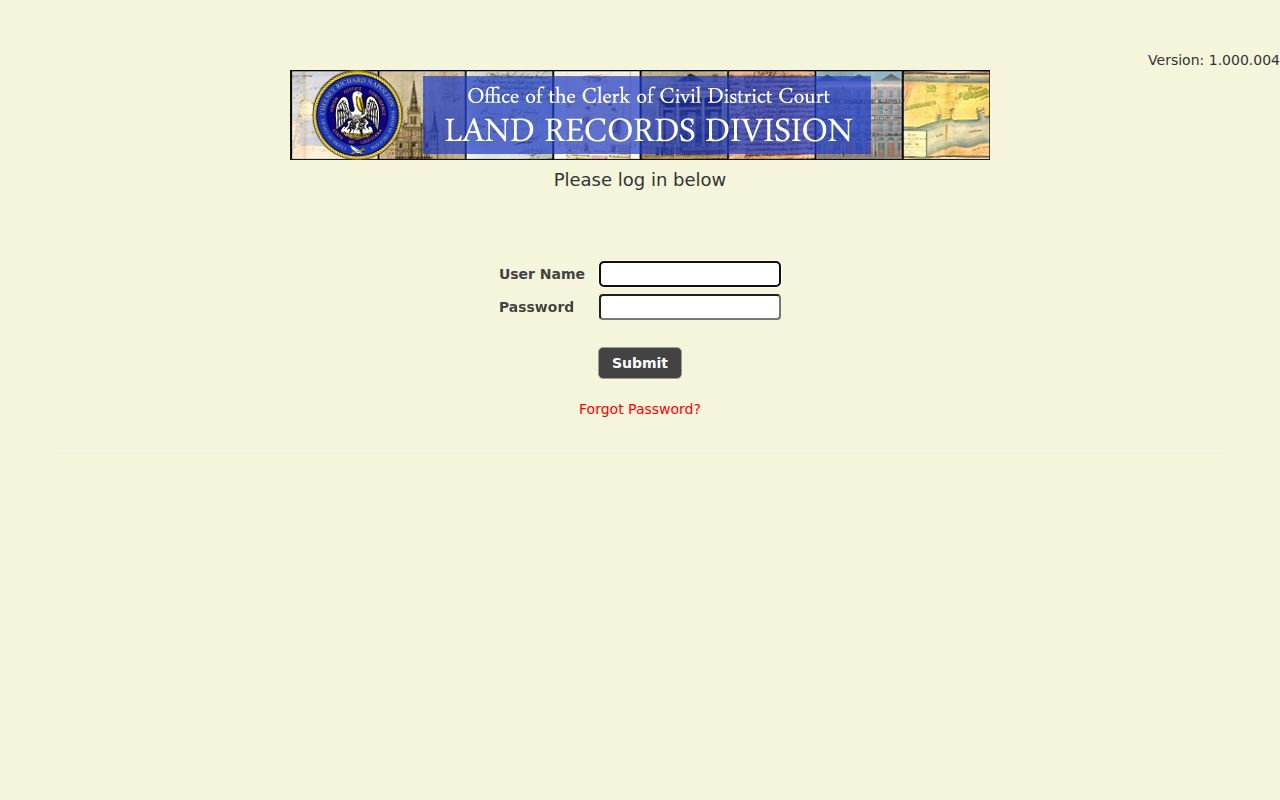
Use its date-bounded index as one link in the deed chain, then confirm the instrument through an image, office terminal, or clerk copy.
Orleans Records Reach to 1735
The Orleans Civil Clerk Research Center holds notarial material from 1735 through July 1970. That span reaches into French and Spanish rule before the Louisiana Purchase. Older acts may require a notary name and act date, annual indexes, bound buyer-and-seller volumes, and translation. Post-July 1970 material is generally keyed by a Notarial Archives number, so the access method changes mid-chain.
This depth makes an Orleans address unusually traceable, but only if the search follows the land description. A modern house number may not exist in an old act. Before concluding that the trail stops, compare the notary, square, lot, prior act, and any attached plat or survey. Current open stacks, supervised historical stacks, office terminals, email requests, and the Research Center are all documented channels. A missing online image is a reason to contact staff, not a reason to erase an owner from the chain.
Orleans House History Beyond Deeds
A transfer date does not prove when a building was erected. The City Archives property guide points beyond title records to maps, surveys, photographs, tax files, and plans.
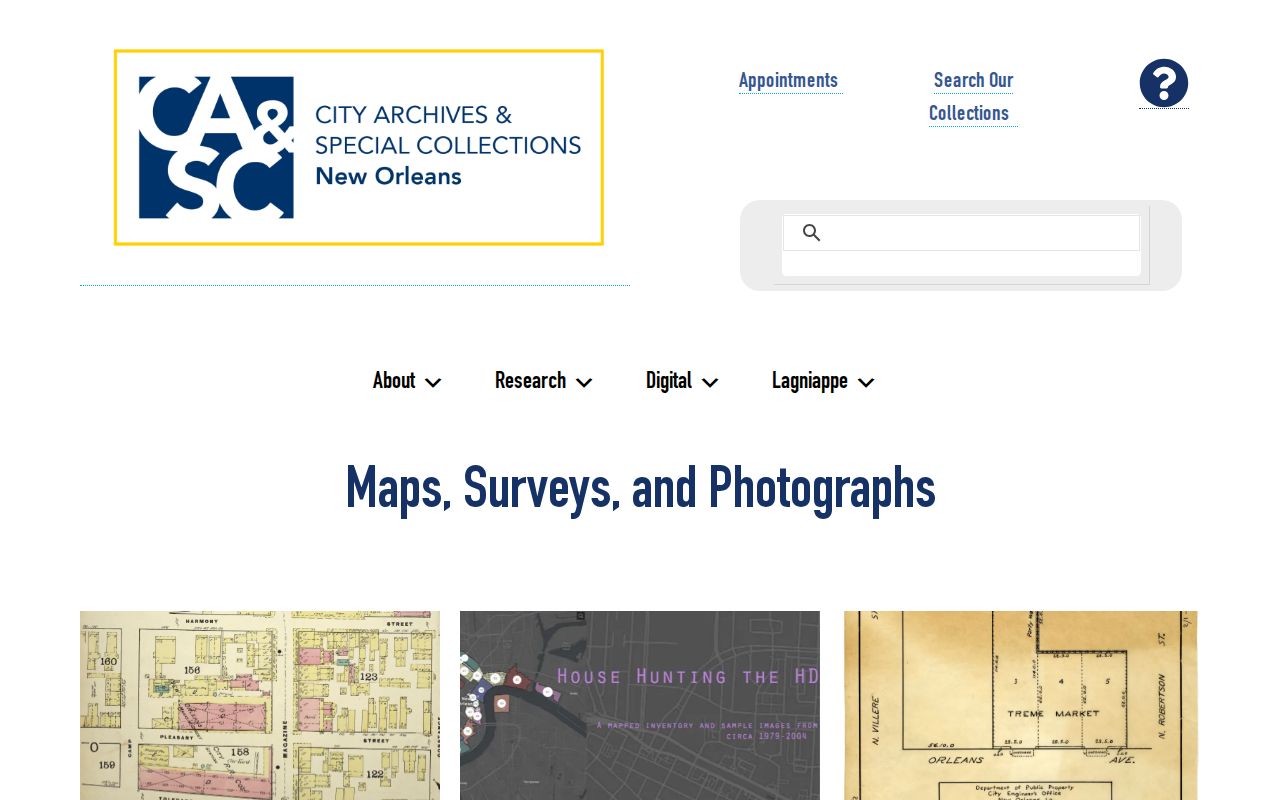
The image anchors a broader house-history sequence: chain of title first, then Sanborn maps, tax assessments, utility and Street Railway records, city directories, newspapers, architecture books, and Vieux Carré material.
Sanborn sheets can show footprint, use, construction material, and lot context. Coverage is reported from 1876 to 1994, but not every year or area survives in one open collection. Street Railway and Sewerage and Water Board connection records cover 1908 to 1964 and can date service to a structure. City Archives tax assessments run from 1836 to 1975, with an incomplete early span. These sources date the property and its changes; they do not name every person who slept there.
Read Orleans Notarial Time Capsules
A recorded notarial act may explain more than the transfer of a name on title. Copy the act type, notary, parties, witnesses, legal description, prior recording reference, mortgage, servitude, and any building contract. An attached sketch or survey can show why a modern lot has an odd shape or why the address no longer matches the one in a directory.
Keep those facts tied to the instrument number and recording date. A party to an act was not always a previous resident of the property. Compare the legal description with the Assessor square, lot, and GEOPIN, then use a directory or census entry to test occupancy. For early material, the Notarial Archives Research Center provides the supervised offline route.
Decode Old Orleans Street Addresses
Street-name changes from 1852 to 1938 and early-1890s number-conversion tables are vital when previous residents disappear between records. The conversion tables use current hundred-block and cross-street logic, but they do not promise an exact modern number for every old address. Some changes before 1923 never entered an ordinance table, and many later changes fall outside the published name list.
The City Archives street-name resource provides the documented bridge.
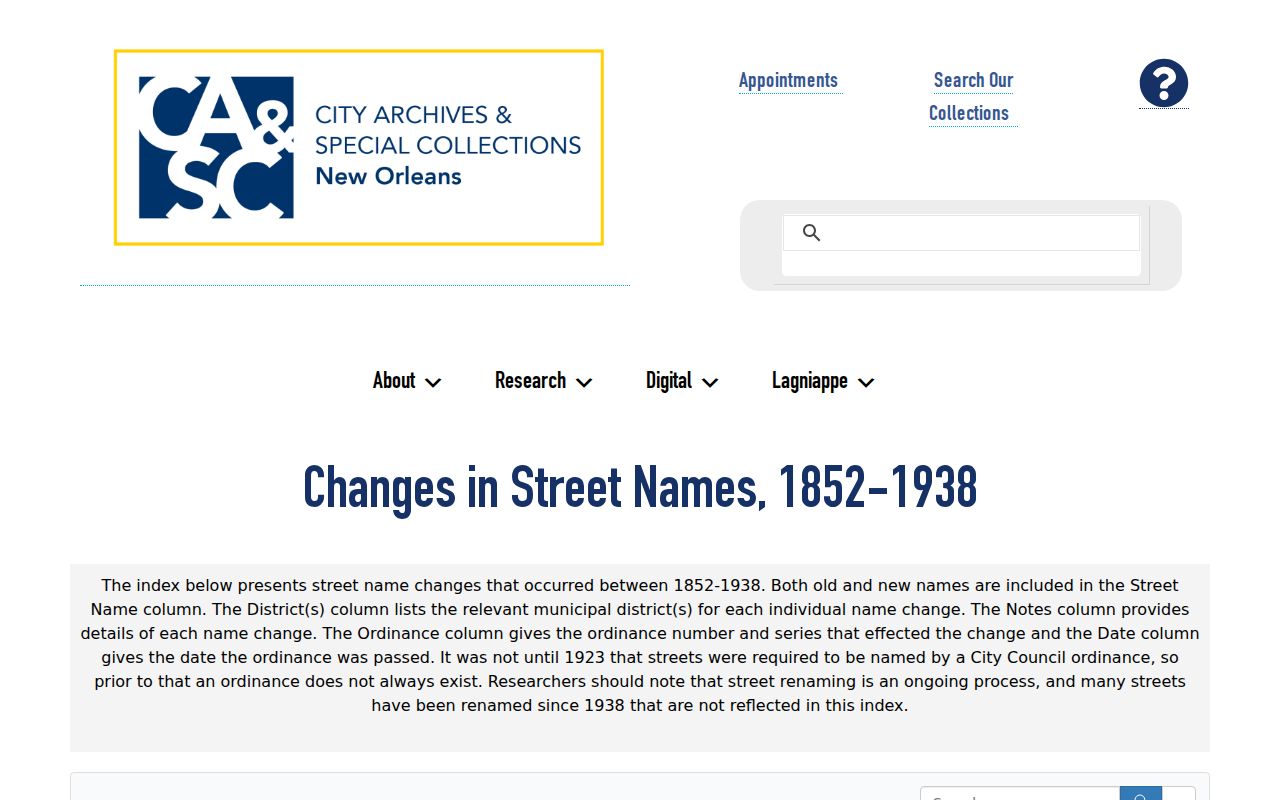
Search both names in adjacent directory years. Also compare cross streets, square, municipal district, and the deed's legal description before treating two forms as different places.
Match Orleans Residents Across Years
Owners are only half of an address history. A directory can identify a renter, spouse, occupation, business address, or head-of-household marker. After 1932, reverse or criss-cross books let a researcher start with the street address. The full shelf and abbreviation system are covered in the Orleans Parish city directory resource.
Use a short repeatable flow: directory year to name and residence, then census year to household, then deed or tax file to owner, then newspaper or obituary to movement and kin. Check one year before and after each hit. Initials, married names, widow notation, OCR errors, and non-head occupants can all cause a false blank. No directories survive for 1862 through 1865, and other years have gaps.
For a person whose trail ends, search the Louisiana State Archives historic Orleans death index.
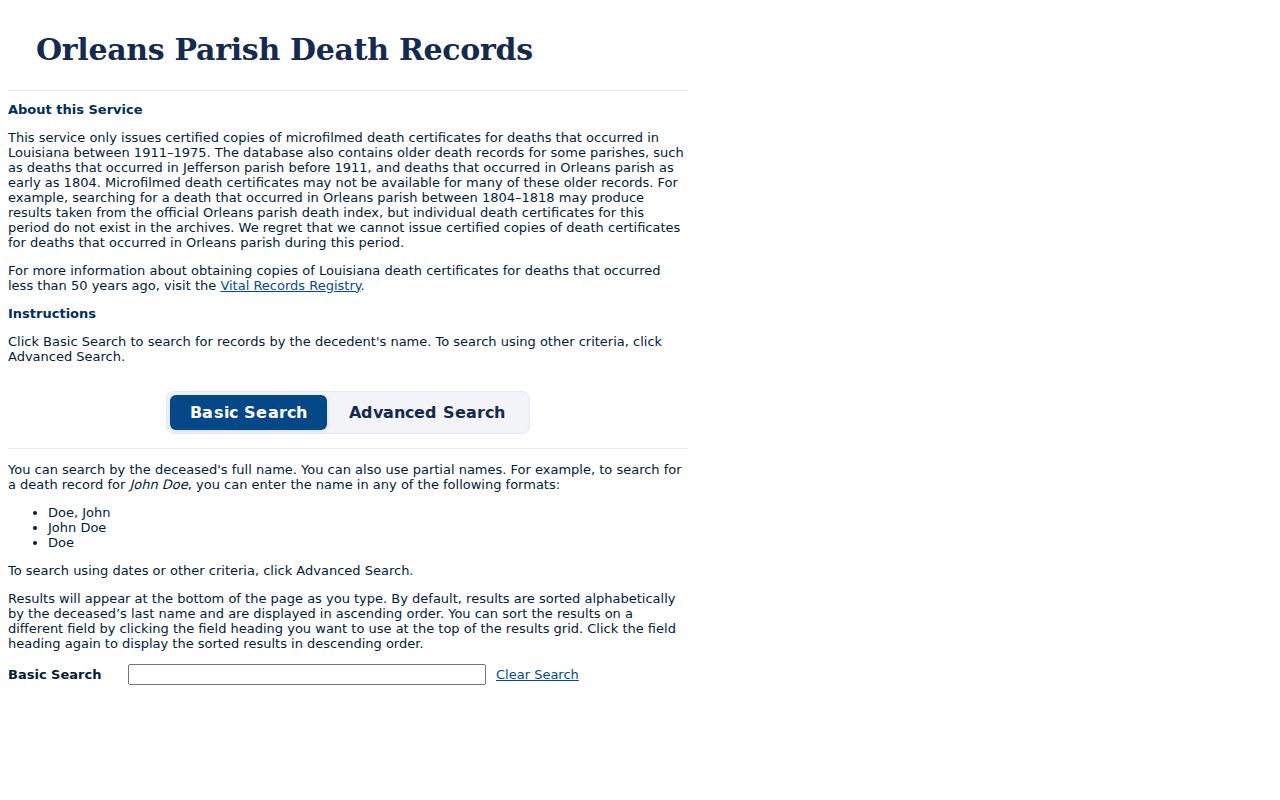
A death-index match can lead to the City Archives obituary index, newspapers, church registers, cemetery records, and succession files. The obituary index covers 1804 to 1972 and more than 650,000 names, but an index entry is still a lead to the notice, not proof of every address detail.
Limits on Orleans Previous Residents
Property records identify title holders, not a complete household. A tax mailing address can belong to an attorney, business, relative, or owner living elsewhere. Homestead information may support an owner-occupancy clue, yet it does not list each person in the home. Directories omit people, census access follows a release rule, and current vital certificates are closed to most requesters under Louisiana eligibility rules.
Lawful use. Trace Orleans Parish previous residents for house history, family history, heirs, or personal research. Never use an address trail to watch, harass, or harm a living person.
Keep claims narrow. Write that a deed names an owner, a directory lists a person at an address, or a census places a household there on its enumeration date. When sources disagree, preserve both entries and their dates. That approach makes the history useful without turning a clue into an unsupported claim.